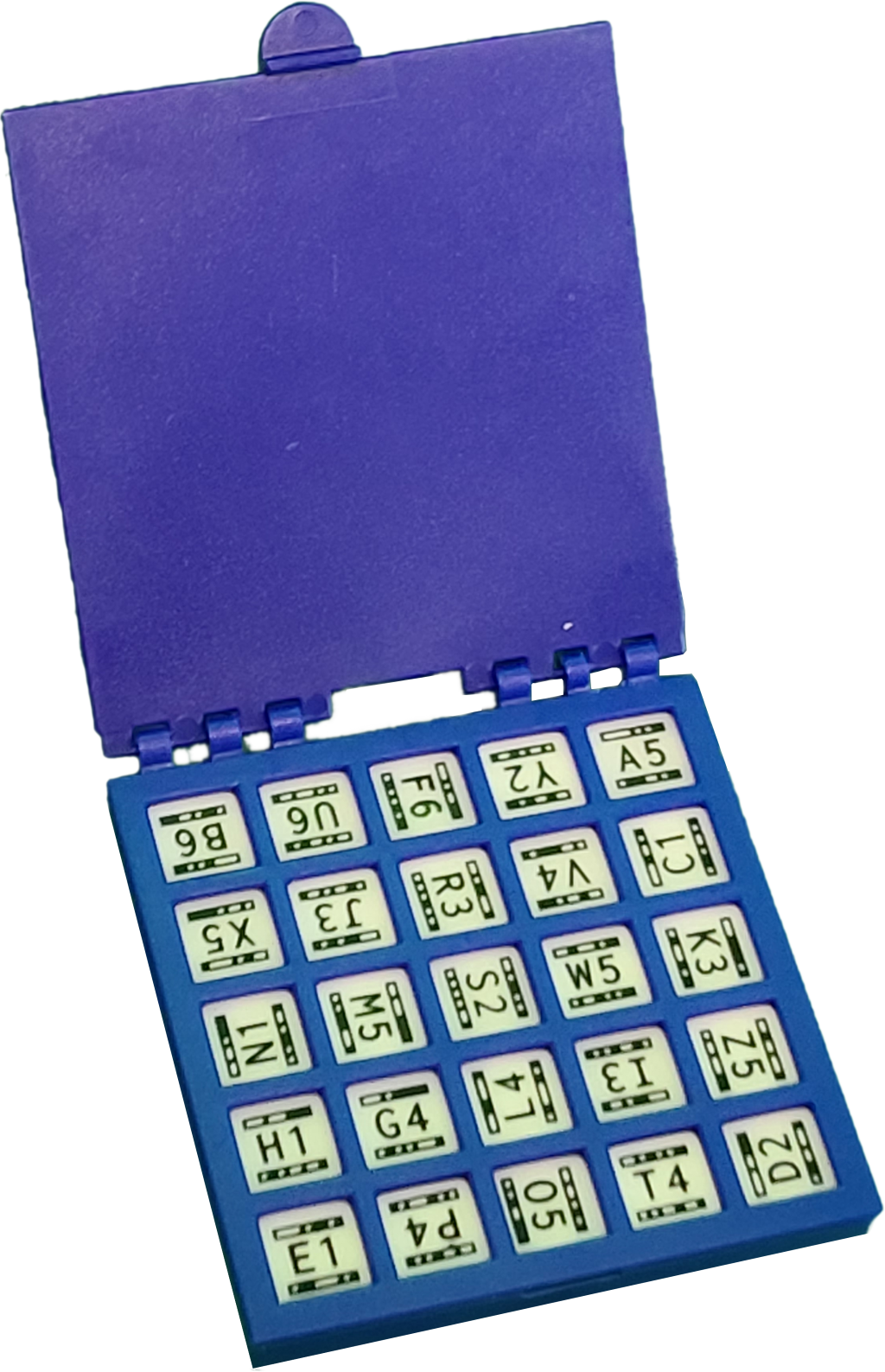
DiceKeys can be read by most any phone, tablet, or computer.
Or, you can use your own eyes to read each face by its:
letter, which identifies the die
digit, which identifies the face of the die, and
orientation (rotation) of the face relative to the box
The lines and dots are error-correction codes.
Each line contains a redundant encoding of the letter and digit on the face of the die.
Our algorithms use them to orient and double check the letter and digit.
Open and tangible
Our open software for reading DiceKeys
and performing cryptographic operations with them
is available for you to inspect, compile, modify, and use for eternity.
In contrast to hardware designed to resist inspection,
you can inspect every aspect of DiceKeys
with your own eyes.
Your security is literally in your own hands.
Designed to last a human lifetime
Most products are designed to be replaced,
and many technology products are designed to be replaced dozens of times over a human lifetime.
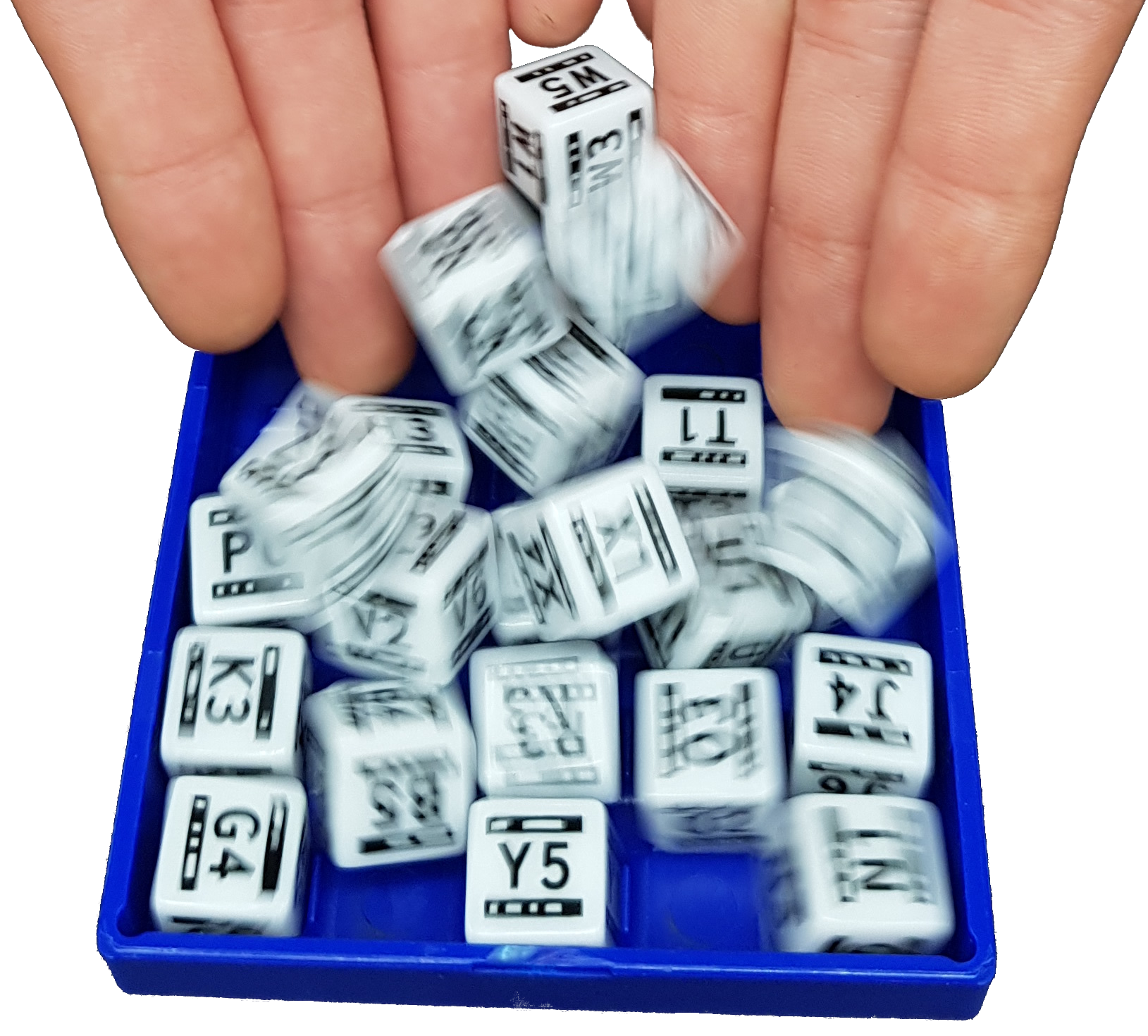
In contrast, one need only open up a decades-old game to observe the longevity of dice.
Future-proof
In 50 years, our devices may no longer support Bluetooth or USB-C, but we will still have
eyes and our devices will still have cameras.
Even if the company behind
DiceKeys
is long gone,
our license gives you access to use our software for eternity, and allows the open-source
community to maintain and improve it.
Our first shipment of DiceKeys are available for pre-order from
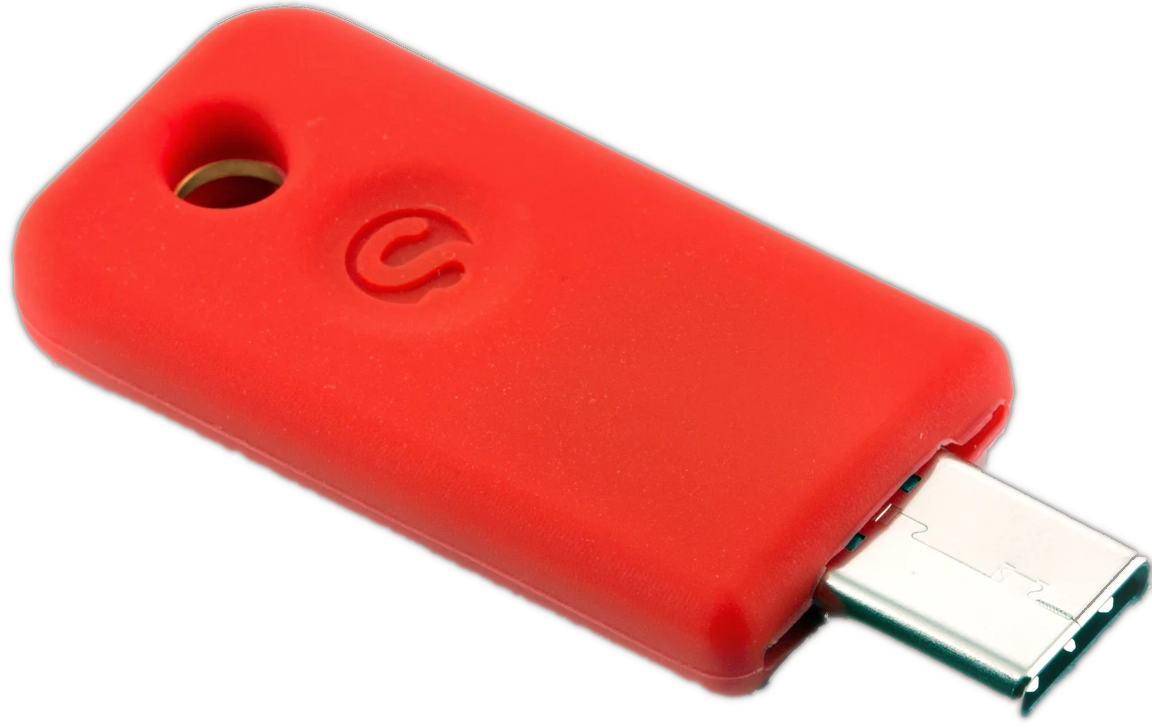
Crowd Supply paired with a
SoloKey ,
so that you can seed the SoloKey from your DiceKey and replace the
SoloKey with a cryptographically-identical replica if you break or lose it.
Partners, developers, and members of the press can
contact us
for test units, which have completed manufacturing are en route to our distributor.
Software
Use the DiceKeys app
(https://dicekeys.app) to read your
DiceKey.
Our API allows apps and services to derive their own private secrets from your
DiceKey without
seeing the key itself.
Our reference implementation runs in most modern web browsers, allowing it to
work on an incredibly diverse range of devices.
While built with web-based technologies (TypeScript & WebAssembly), it runs
entirely locally on your device.
We are also developing Android and iOS versions to provide a richer experience
on those devices.
Stuart's career as an inventor and researcher in the field of usable security research spanned his years at Microsoft Research, MIT Lincoln Laboratory, and his PhD at Harvard University. He currently teaches Usable Privacy and Security for the University of California at Berkeley's Master's Program in Cybersecurity.
Joseph Bonneau is an Assistant Professor at NYU and was formerly affiliated with Stanford, Princeton, Cambridge (PhD), the Electronic Frontier Foundation, Google, Yahoo, and Cryptography Research.
He is known for groundbreaking work on authentication, including analysis of 70m passwords at Yahoo, and for his security analyses of cryptocurrencies.
Of particular relevance for DiceKeys, he created the word lists for EFF's DiceWare, a technology to help users to create phrase-based passwords from standard dice.
Bruce Schneier is an internationally renowned security technologist, called a "security guru" by The Economist. He is the author of over one dozen books--including his latest, Click Here to Kill Everybody--as well as hundreds of articles, essays, and academic papers. His influential newsletter "Crypto-Gram" and his blog "Schneier on Security" are read by over 250,000 people. He has testified before Congress, is a frequent guest on television and radio, has served on several government committees, and is regularly quoted in the press. Schneier is a fellow at the Berkman Klein Center for Internet & Society at Harvard University; a Lecturer in Public Policy at the Harvard Kennedy School; a board member of the Electronic Frontier Foundation, AccessNow, and the Tor Project; and an Advisory Board Member of the Electronic Privacy Information Center and VerifiedVoting.org.
*To generate secrets consistently even if you scan your
DiceKey sideways or rotated up-side down,
our software rotates your DiceKey to a
canonical orientation before deriving secrets from it.

 =
=

 ,
so that you can seed the SoloKey from your DiceKey and replace the
SoloKey with a cryptographically-identical replica if you break or lose it.
,
so that you can seed the SoloKey from your DiceKey and replace the
SoloKey with a cryptographically-identical replica if you break or lose it.